


Night Hot Flashes: What's Happening in Your Body and How to Address It
They appear when everything should be calm. Understanding their precise physiological mechanism is the first step to acting with discernment.
At a Glance
- The drop in estrogen narrows the hypothalamus's thermoneutral zone, making the body hypersensitive to even minimal temperature variations.
- Nighttime amplifies the phenomenon: the natural thermoregulation of sleep directly conflicts with this dysregulated mechanism.
- Night sweats fragment sleep architecture and reduce deep sleep, with measurable consequences on mood, cognition, and metabolism.
- Certain micronutrients and traditional herbs are the subject of growing scientific literature as support for this transition.
The Hypothalamus and the Thermoneutral Zone: The Precise Mechanism
To understand nocturnal hot flashes, we must start with a brain structure rarely discussed outside of textbooks: the hypothalamus. It regulates body temperature, maintaining the body within what physiologists call the thermoneutral zone — a temperature range within which the body does not need to sweat or shiver to remain stable.
Under normal conditions, this zone extends about 0.4 to 0.8 °C. When estrogens circulate at sufficient levels, they help maintain this broad and stable range. But during perimenopause and menopause, the drop in estrogens alters the sensitivity of thermoregulatory neurons — particularly the KNDy neurons (kisspeptin/neurokinin B/dynorphin) of the hypothalamus, which become hyperactive in the absence of estrogens.
The result is documented: the thermoneutral zone drastically narrows, sometimes almost disappearing completely. A minuscule elevation in core body temperature — on the order of 0.1 to 0.2 °C — is enough to trigger the body's cooling response: peripheral vasodilation, intense sweating, a sensation of radiating heat. This is commonly known as a hot flash.

Estrogen drop
Perimenopause or menopause
KNDy neuron hyperactivity
Hypersensitive hypothalamus
Narrowed thermoneutral zone
Lowered trigger threshold
Cooling response
Vasodilation · sweating
Note
KNDy neurons only respond to sufficient concentrations of estrogen. Neurokinin B — one of their neuropeptides — is a powerful trigger for hot flashes. Research published in The Lancet (2022) identified its receptor as a potential therapeutic target, confirming the robustness of this mechanism.
Why do hot flashes intensify at night?
The question constantly comes up in consultations: "Why is it always worse at night?" The answer lies in a particularly cruel physiological conflict. The human body is programmed to naturally lower its core temperature by about 0.3 to 0.5 °C during the first hours of sleep — this is one of the biological signals that allows for falling asleep and entering deep sleep.
This cooling is active: it occurs through peripheral vasodilation, mainly in the hands and feet. However, this is exactly the same mechanism as that triggered during a hot flash. In other words, both processes use the same physiological pathways, and at night, they directly collide.
Added to this is a positional factor: when lying down, body heat redistributes differently than when standing. Blankets, bedding, the body heat of a potential partner — all these elements slightly raise the ambient temperature perceived by the hypersensitive hypothalamus, multiplying potential triggers.
What this concretely changes
If you sleep in a room at 20 °C when you used to sleep well at 19 °C before perimenopause, the differential can be enough to trigger several episodes in the same night. This is not heightened sensitivity; it's applied biology.
Data from perimenopause versus established menopause show that nocturnal hot flashes can begin up to 4 to 6 years before the last period — long before many women connect it to their hormones.

The real impact on sleep architecture
Night sweats are not just uncomfortable. Their impact on sleep is measurable and documented — and it goes far beyond next-day fatigue.
What happens in sleep cycles
Sleep occurs in cycles of about 90 minutes, alternating between light sleep, deep sleep (slow-wave and restorative), and REM sleep. A nocturnal hot flash causes a micro-arousal, often too brief to be consciously remembered, but enough to interrupt the ongoing cycle. The sleeper then restarts a cycle from the beginning, never reaching the deepest stages with the necessary regularity.
A study published in Sleep Medicine Reviews (Freeman et al., 2015) objectively measured the sleep architecture of perimenopausal women with polysomnographic recordings. It confirmed that the frequency of nocturnal hot flashes directly correlates with the reduction of slow-wave sleep — the most restorative phase — and increases the number of nocturnal micro-arousals.
| Frequency of nocturnal hot flashes | Impact on deep sleep | Observed daytime consequences |
|---|---|---|
| 1–2 episodes / night | Slight reduction in slow-wave sleep | Moderate morning fatigue, possible recovery |
| 3–5 episodes / night | Significant fragmentation of cycles, significant reduction in REM | Irritability, difficulty concentrating, short-term memory issues |
| 6+ episodes / night | Severely disrupted sleep architecture | Cognitive impact, mood, metabolism, immune system |
The closing circle
Lack of deep sleep itself exacerbates stress sensitivity and disrupts cortisol secretion. High cortisol levels in the evening further lower the hot flash trigger threshold. Hot flashes disrupt sleep, which disrupts cortisol, which amplifies hot flashes. Understanding this circle means understanding why the approach cannot be solely symptomatic.
Signs you might benefit from supplementation
There is no single blood test that prescribes supplementation. The decision relies on a cluster of signals. Here are those that deserve attention, without dramatizing or minimizing.
Regular sweaty awakenings
Three or more episodes per week, accompanied by an intense feeling of heat, wet sheets, or a need to change clothes at night.
Daytime brain fog
Unusual difficulty concentrating, words escaping, less reliable short-term memory. These signs can be directly related to chronic deep sleep deprivation.
Fatigue that doesn't yield to rest
Sleeping 7 hours and waking up as tired as before — a characteristic sign of quantitatively sufficient but qualitatively degraded sleep.
Uncertain micronutrient intake
The need for B vitamins, magnesium, and vitamin D increases during the menopausal transition. Suboptimal dietary intake can exacerbate hypothalamic sensitivity.
Scientific Reference
A cohort study published in the Journal of Clinical Sleep Medicine (Kravitz et al., 2011, from the SWAN study) followed 3,302 women in menopausal transition for several years. It established that women experiencing frequent nocturnal hot flashes reported significantly more sleep disturbances, and that this relationship persisted even when accounting for anxiety and depression as confounding factors.
What research says: documented nutritional approaches
Supplementation does not replace gynecological follow-up. It complements it. Several micronutrients and traditional herbs are the subject of growing scientific literature, and here is an honest overview.

B vitamins and energy regulation
Vitamins B6, B9, and B12 play a documented role in normal energy metabolism and nervous system function. According to EU Regulation No 432/2012, they contribute to the normal functioning of the nervous system and to the reduction of fatigue. In the context of perimenopause, the need for vitamin B6 is particularly relevant: it contributes to the normal regulation of hormonal activity (recognized EFSA claim), making it a key micronutrient in this transition window.
Vitamin B6 also participates in the synthesis of serotonin and melatonin — two neurotransmitters directly involved in sleep quality and mood regulation. Optimal intake is not incidental in this context.
Phytoestrogens: what the available literature says
Red clover, maca, and dong quai are plants traditionally used in the context of menopausal transition. Their use is ancient, documented in several medical traditions, and they are now the subject of clinical studies whose results deserve rigorous interpretation.
Red Clover
PhytoestrogensRich in isoflavones (formononetin, biochanin A). Several randomized trials explore its action on thermal comfort. Established traditional use.
Maca
AdaptogenAndean plant studied for its impact on general well-being in perimenopause. Its mechanism of action is not estrogenic — it is thought to act via the hypothalamic-pituitary axis.
Dong Quai
Traditional UseAngelica sinensis, a flagship plant in traditional Chinese medicine. Used in formulations to support comfort during the menopausal transition.
What research says about isoflavones
A meta-analysis published in Menopause (Taku et al., 2012) of 19 randomized trials analyzed the effect of soy and red clover isoflavones on hot flashes. It concluded a significant reduction in the frequency of episodes compared to placebo, while highlighting the heterogeneity of the formulations studied. The bioavailability of these compounds varies considerably depending on the galenic form — which makes the liquid matrix particularly relevant for maximizing assimilation.
Important: these plants are not hormone substitutes. They do not regulate hormones in the clinical sense of the term. They are part of a nutritional support approach, distinct from hormone replacement therapy.
The role of bioavailability in perceived efficacy
A parameter rarely discussed when talking about supplementation is bioavailability — that is, the proportion of the active ingredient that actually reaches the bloodstream. A capsule formulation goes through a process of mechanical and chemical dissolution in the stomach before being absorbed. A liquid formulation begins to be absorbed from the oral mucosa and esophagus.
Data published in the Journal of Nutritional Biochemistry indicate that liquid forms show an absorption rate up to 3 times higher than solid forms for certain micronutrients. This is not marketing — it is pharmacokinetics.
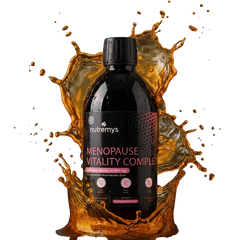
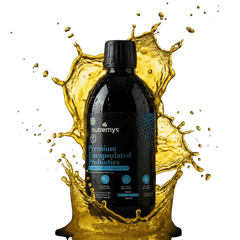
To explore the specific formulation designed by Nutremys to support the menopausal transition, find the 9 active ingredients of the Menopause Vitality Complex and details of each ingredient on the product page.
Menopause Vitality Complex · Nutremys LAB
9 active ingredients. A liquid formulation. Supported passage.
10,000 mg marine collagen, 8 B vitamins, hyaluronic acid, red clover, maca, dong quai. Formulated for bioavailability, dosed for consistency, designed for women who read labels before buying.
Discover the full formulationFrequently Asked Questions
Are nocturnal hot flashes different from daytime hot flashes?
Physiologically, the trigger mechanism is identical — narrowing of the thermoneutral zone and hypothalamic response. But at night, two factors often make them more intense: the body's natural thermoregulation during sleep directly conflicts with this mechanism, and the bedding environment (temperature, blankets) multiplies potential triggers.
Night sweats are generally more abundant than daytime hot flashes, as the body produces more perspiration to compensate in a confined environment.
When in perimenopause do nocturnal hot flashes typically begin?
Data from the SWAN study, one of the largest cohorts on women's health during menopausal transition, show that hot flashes can appear 4 to 6 years before established menopause (defined as 12 months without periods). They therefore often occur at a time when menstrual cycles are still present but irregular.
This is why many women do not immediately make the connection. If you are between 42 and 50 years old and experience unusual sweaty awakenings, the hormonal aspect should be explored with your gynecologist.
Does room temperature really make a difference?
Yes — and it's one of the few entirely controllable variables. Data from the Journal of Physiological Anthropology suggest that a room kept between 16 and 18 °C significantly reduces the frequency of nocturnal episodes in women experiencing hot flashes.
Natural fiber sheets (linen, tightly woven cotton) and a memory foam pillow with low heat retention are simple adjustments that have a real impact. These are not remedies, but facilitating conditions.
Are phytoestrogens safe for all women?
Dietary phytoestrogens (soy, red clover, flax) are generally well tolerated by the majority of women. However, certain situations deserve special attention: women with a history of hormone-dependent cancer should always consult their oncologist before any phytoestrogen supplementation, even of plant origin.
This is a subject where honesty is essential. Traditional herbs are not neutral — that's precisely why they can be relevant, and why they deserve medical supervision in certain clinical contexts.
How long does it take to see an effect from nutritional supplementation?
Clinical trials on isoflavones and B vitamins generally observe measurable results from 8 to 12 weeks of regular intake. It's not instantaneous — and any claim of results in a few days should raise caution.
Nutritional supplementation is part of a progressive support approach, not an immediate correction. Regularity of intake is the most decisive factor in all published trials.
Scientific Sources
- Dacks, P. A. et al. (2011). Kisspeptin neurons as central processors in the regulation of gonadotropin-releasing hormone secretion. Endocrinology, 152(11), 4162–4171. PubMed
- Léger, D. et al. (2022). Neurokinin B and menopause: toward a new era of thermoregulatory treatments. The Lancet, 400(10362), 1561–1563.
- Freeman, E. W. et al. (2015). Associations of objectively and subjectively measured sleep quality with subsequent cognitive decline in older community women. Sleep Medicine Reviews, 24, 37–45.
- Kravitz, H. M. et al. (2011). Trajectories of vasomotor symptoms, sleep, and mood: the Study of Women's Health Across the Nation (SWAN). Journal of Clinical Sleep Medicine, 7(5), 501–509.
- Taku, K. et al. (2012). Extracted or synthesized soybean isoflavones reduce menopausal hot flash frequency and severity: systematic review and meta-analysis of randomized controlled trials. Menopause, 19(7), 776–790.
- Regulation (EU) No 432/2012 establishing a list of permitted health claims made on foods. EUR-Lex
- North American Menopause Society (2023). Menopause Practice: A Clinician's Guide. 6th edition.



The information shared on this blog is for educational and informational purposes only. It does not replace medical consultation, diagnosis or treatment prescribed by a healthcare professional. If you have symptoms, are undergoing treatment or are pregnant, consult your doctor before modifying your diet or starting supplementation. Nutremys LAB food supplements should not replace a varied, balanced diet or a healthy lifestyle.
