






Dizziness and Menopause: Hormonal Causes and Solutions
If you've been feeling dizzy for a few months and your periods are becoming irregular, it's not your imagination. Perimenopause can disrupt your balance — a mechanism still largely underdiagnosed in France.
- Up to 50–60% of women in menopausal transition report dizziness or feelings of instability (clinical review, 2024)
- Estradiol directly modulates inner ear function, blood pressure, and blood sugar
- Benign paroxysmal positional vertigo (BPPV) is significantly more common in perimenopausal women
- Before any hormonal attribution, certain red flags necessitate an ENT or neurological opinion
- An integrated approach — hydration, targeted micronutrition, herbal medicine — reduces the frequency and intensity of episodes
First, let's rule out anything serious
A 49-year-old patient enters my office with a note from her GP: "neurological assessment to be scheduled." She's been dizzy for three months. She suspects a tumor. Normal clinical examination, normal MRI. What she has is eighteen months of irregular periods and no one to tell her that hormonal decline can also affect her inner ear.
Dizziness is one of the most worrying reasons for consultation, and rightly so. Before discussing hormones, it is necessary to rule out a central cause (brain damage, stroke), a cardiological cause (arrhythmia, severe orthostatic hypotension), or a medication-related cause (psychotropics, antihypertensives, certain antiepileptic drugs). This involves a complete clinical examination, sometimes a Doppler of the supra-aortic trunks, sometimes brain imaging.
Once this step is completed, we can begin to think differently. And thinking differently is precisely what French-speaking medicine still does too little: systematically questioning the hormonal status of a woman between 42 and 55 years old who consults for recurrent dizziness.

The estrogen – inner ear connection that medicine still ignores
Estradiol — the main form of estrogen before menopause — is not just a reproductive hormone. It acts as a neuromodulator on receptors distributed throughout the body, including the inner ear and the vestibular system. When its level drops, several things happen in parallel.
Otoliths become less stable
The regulation of otoliths — these small calcium carbonate crystals that inform the brain about head position — becomes less stable. This is why benign paroxysmal positional vertigo (BPPV) is significantly more common in perimenopausal women. A Taiwanese study published in Frontiers in Aging Neuroscience showed that women on hormone replacement therapy have a lower rate of BPPV than untreated women of the same age. The suggested mechanism: a protective effect of estrogens on otolith fixation and on the bone density of the labyrinth.
Vestibular migraine increases in frequency
Vestibular migraine — attacks that combine rotational vertigo, nausea, and sometimes headache — becomes more frequent. Perimenopause, with its sudden hormonal fluctuations, is a classic period for the onset or worsening of this condition. Many women who had never had migraines before "experience" their first attack around age 47.
A PRISMA review published in 2023 identifies estrogen receptors in the lateral vestibular nucleus, the cochlea, and the otoconial epithelium. The drop in estradiol modifies the expression of these receptors and alters the calcium signaling of the inner ear — a mechanism directly involved in postmenopausal BPPV.
In my clinical practice, I often see women who have had a few episodes of dizziness with no clear diagnosis, followed a few months later by hot flashes or insomnia. Dizziness was the first hormonal signal. No one had interpreted it as such.
Blood pressure, blood sugar, iron: other hormonal mechanisms
Estrogens also influence your blood pressure. As they decrease, blood pressure becomes more unstable, particularly when standing up. This relative orthostatic hypotension causes feelings of lightheadedness, blurred vision, and the ground moving. Many patients describe this as "dizziness" when it is actually a blood pressure disorder.
Blood sugar also plays a role. Perimenopause is often accompanied by more pronounced insulin resistance, and drops in blood sugar between meals can generate instability, sweating, and feelings of faintness. A simple adjustment of protein intake at breakfast can sometimes change everything — an observation I make in consultation every week.
Iron or vitamin B12 deficiency, common after age 45, can also manifest as dizziness. Ferritin below 30 µg/L is rarely checked in adult women; it should be systematically checked in those who consult for fatigue or instability. To go further, read our guide on the signs of protein deficiency after age 40 and our complete overview of vitamin D3, two silent deficiencies in perimenopausal women.

When a specialist's opinion is necessary
Not all dizziness is hormonal. Certain signs require an ENT or neurological opinion without delay. I insist on this: attributing dizziness "to menopause" too quickly without having ruled out an organic cause is a medical error, not a time-saver.
| Symptom | Course of action |
|---|---|
| Intense rotational vertigo persisting for more than a few hours | Urgent ENT opinion |
| Sudden unilateral hearing loss, new tinnitus | Urgent ENT (within 48 hours) |
| Visual disturbance, speech disturbance, weakness in a limb | Neurological emergency department |
| Sudden thunderclap headache | Emergency department (15) |
| Repeated falls, major balance disorders | Scheduled neurological consultation |
| Mild to moderate dizziness, irregular periods, fatigue | Hormonal and iron assessment |
Alleviating daily dizziness — the integrated approach
When the assessment is reassuring and the hormonal context is clear, several levers work in synergy. No single one does everything, but combined over three to four months, the results in consultation are clear.
Hydration and sodium first
Many perimenopausal women are chronically hypovolemic without knowing it. I recommend 1.8 to 2 liters of water spread throughout the day, and not to be afraid of a little salt — unless confirmed hypertension. A simple pinch in a glass of lemon water in the morning can transform morning blood pressure stability.
Magnesium and B vitamins
Glycinate or bisglycinate magnesium, 300-400 mg at the end of the day, stabilizes neuromuscular transmission and improves sleep. The latter point matters: fragmented sleep directly aggravates next-day dizziness. Vitamins B6, B9, and B12 support neurotransmitter production and central vestibular function. Targeted supplementation is justified when diet is insufficient — which is most often the case after age 45.
Phytoestrogens and Adaptogens
Phytoestrogens — red clover, fermented soy — provide gentle support for estrogen fluctuations, without replacing HRT when it is indicated. Dong Quai, an adaptogenic plant used in traditional Chinese medicine, and Andean Maca, are historically used for hormonal regulation and energy. Clinical data remain limited, but consultation feedback over three to four months is often favorable for mood stability, sleep, and instability.
A very simple exercise I give my patients: sitting on the edge of the bed, gently turn your head from left to right for 30 seconds, twice a day. This is a basic vestibular rehabilitation. The balance system, like a muscle, can be retrained. Many women see improvement in two to three weeks.
Signs you might benefit from supplementation
- Mild to moderate dizziness for more than six weeks, with no signs of severity
- Irregular periods or recent amenorrhea
- Diffuse fatigue, fragmented sleep
- Associated hot flashes, vaginal or skin dryness
- Normal ENT and neurological assessment
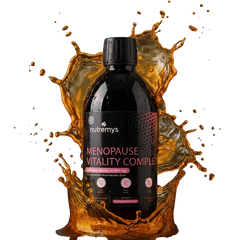
In this configuration, a combined formula — marine collagen for tissue support, B vitamins for the nervous system, adaptogenic plants and phytoestrogens for hormonal regulation — can provide gradual relief over three to four cycles. This is precisely the formulation logic of the Menopause Vitality Complex: nine active ingredients in liquid form, with up to three times higher bioavailability than capsules. To understand the broader context, you can also read our complete guide to menopause symptoms.

What conventional medicine still too often ignores: dizziness in perimenopause is not a whim of fatigue, nor a marker of age. It is a measurable signal. Listening to it early saves you months of diagnostic wandering and a lot of unnecessary worry.
Frequently Asked Questions
Yes, in some cases. When hormone levels stabilize after confirmed menopause, hormonal dizziness often subsides. But this can take 12 to 36 months, and in the meantime, these episodes affect your sleep, your confidence, and sometimes your safety — risk of falling. There's no reason to passively endure them when solutions exist.
Data suggests that HRT reduces the frequency of BPPV in postmenopausal women. However, it is not prescribed for this indication alone. If HRT is indicated for other reasons — severe hot flashes, dryness, bone protection — the improvement in dizziness can be a secondary benefit. This decision is always made with your gynecologist, after a personalized assessment.
Allow eight to twelve weeks to evaluate a real effect on hormonal symptoms. Initial improvements — better sleep, more stable energy, fewer episodes — often appear within three to four weeks. A relevant trial lasts at least three months, ideally four. Below that, you won't know if the formula works for you.
No, provided a serious cause has been ruled out. Inactivity actually worsens dizziness by de-training the vestibular system. Walking, yoga, and swimming maintain balance and naturally stimulate vestibular rehabilitation. Only avoid activities with a risk of falling during acute periods — cycling in traffic, climbing, horse riding.
A useful minimum assessment: FSH, LH, estradiol, TSH, ferritin, fasting blood glucose, vitamin B12, vitamin D 25(OH). Depending on the context, an ENT consultation with a Dix-Hallpike maneuver to check for BPPV. If associated headaches, a neurological opinion for vestibular migraine. This panel is inexpensive and highly informative.
Menopause Vitality Complex combines marine collagen, 8 B vitamins, hyaluronic acid, Dong Quai, red clover, and Maca in a highly bioavailable liquid formula. Designed for perimenopause, manufactured in Europe under GMP certification.
See Menopause Vitality Complex →- Mehta A. et al. (2024). Balance in Transition: Unraveling the Link Between Menopause and Vertigo. Cureus.
- Faralli M. et al. (2025). Is there any relationship between the menopause transition and dizziness? A narrative review. Brazilian Journal of Otorhinolaryngology.
- Liao W.-L. et al. (2017). Age-Related Increases in BPPV Are Reversed in Women Taking Estrogen Replacement Therapy. Frontiers in Aging Neuroscience.
- Chu C.-H. et al. (2022). Serum Estradiol Correlates With BPPV in Postmenopausal Women. Endocrine Practice.
- Gallego-Martinez Á. et al. (2023). Vestibular Disorders and Hormonal Dysregulations: State of the Art and Clinical Perspectives. Journal of Clinical Medicine.

Gynecologist practicing in Paris for 18 years, specialized in women's hormonal health, perimenopause and menopause. At Nutremys LAB, she brings her medical perspective to every product we offer.
Learn more →
The information shared on this blog is for educational and informational purposes only. It does not replace medical consultation, diagnosis or treatment prescribed by a healthcare professional. If you have symptoms, are undergoing treatment or are pregnant, consult your doctor before modifying your diet or starting supplementation. Nutremys LAB food supplements should not replace a varied, balanced diet or a healthy lifestyle.
