


Marine Collagen and Menopause: What the Science Truly Says
During menopause, skin can lose up to 30% of its collagen in five years. This guide examines the precise biological mechanisms of this loss, what hydrolyzed marine collagen supplementation can — and cannot — do to address it, and how to integrate it into a coherent nutritional strategy.
What you will read in this article
Collagen accounts for 30% of the body's total protein. It is the structural framework of skin, bones, arteries, and joints — not a cosmetic ingredient, but a functional protein whose decline during menopause has measurable and documented biological consequences.
This article elaborates on the mechanisms by which the drop in estrogen destabilizes collagen production, explains why the hydrolyzed form of marine collagen is the most relevant in terms of bioavailability, details the dosages and cofactors validated by clinical literature, and provides an honest timeline of observed results in studies. Every claim is sourced. Every limitation is named.
This article is for informational purposes only and does not replace personalized medical advice. Consult your doctor or gynecologist before initiating any supplementation, especially if you are undergoing menopausal hormone therapy.
Collagen, an invisible architecture
Before discussing supplementation, it is important to understand what collagen actually is — because this term has become a marketing argument before it became a scientific term, and the confusion between the two does not serve your health.
Collagen is a family of fibrous proteins that make up the extracellular matrix of most connective tissues. There are 28 distinct types, numbered I to XXVIII. Type I — the most abundant in the body — forms the fibers that give strength and density to skin, tendons, ligaments, and bones. Type III is associated with skin and vascular elasticity. These two types are precisely those that decline most rapidly during menopause.
Collagen production follows a precise biological cycle. Fibroblasts — specialized cells of connective tissue — synthesize procollagen molecules from amino acids, primarily glycine, proline, and hydroxyproline. This synthesis absolutely requires vitamin C as an enzymatic cofactor: without it, the formation of cross-links that stabilize the fibers is biologically impossible, which explains the severe cutaneous manifestations of scurvy. Once assembled, the fibers form a three-dimensional network that gives skin its firmness and bone its resistance to bending.
This network is not static. It is constantly renewed: enzymes called matrix metalloproteinases (MMPs) degrade old fibers while fibroblasts synthesize new ones. The balance of this process is finely regulated — notably, and this is where menopause comes in, by estrogens.

Collagen is not just another cosmetic ingredient. It is a structural protein on which the mechanical integrity of the skin, bone strength, and joint mobility depend. Understanding it as such changes how one evaluates supplementation — and the expectations one has of it.
What menopause does to this architecture
Estrogen receptors (ER-α and ER-β) are present in skin fibroblasts, osteoblasts, and chondrocytes. This is no coincidence: estrogens exert direct regulation on collagen metabolism at two levels simultaneously.
On one hand, they stimulate the transcription of genes encoding type I and III collagen — in other words, they activate production. On the other hand, they inhibit the matrix metalloproteinases responsible for its degradation. When estrogen levels drop during menopause, both of these regulations collapse at the same time: synthesis slows down and degradation accelerates. This is a scissor effect whose consequences are measurable.
A study published in the British Journal of Dermatology (Brincat et al., 1987) showed that skin collagen concentration declines by about 2% per year after menopause, with an initial drop that can reach 30% in the first five years. These data have been confirmed by dermal ultrasound imaging studies that directly quantify collagen fiber density in the dermis.
Beyond the skin: bones, joints, pelvic floor
This decline is not limited to the cutaneous sphere, and it is important to understand this to assess the benefit of supplementation. Collagen forms about 30% of bone mass — it is the organic framework on which hydroxyapatite crystals attach. The loss of this framework partly explains why bone density decreases so rapidly during menopause, and why calcium intake alone is not enough without the protein infrastructure that retains it.
Joints are also affected. Articular cartilage is composed of 60-70% type II collagen; its progressive thinning explains some of the joint pain that many women describe as early as perimenopause. The pelvic floor, whose connective tissue is rich in type I and III collagen, is also affected — contributing to the risk of prolapse and stress incontinence that increases after menopause.
A meta-analysis published in Frontiers in Endocrinology in 2025 focusing on postmenopausal women confirmed that the combination of collagen + calcium + vitamin D significantly improves bone mineral density, with a greater effect than that of calcium + vitamin D alone. These results are consistent with the mechanistic understanding of the role of the collagen framework in bone mineral retention.

Why hydrolyzed marine collagen
Not all collagens are equal in terms of bioavailability — and this is precisely where the distinction between an effective supplement and an expensive one lies.
Native collagen molecules, regardless of their origin, are too large to pass through the intestinal mucosa intact. Their molecular weight, exceeding 300,000 daltons, far exceeds the absorption capacity of the enterocyte. Enzymatic hydrolysis solves this problem by breaking down long protein chains into short fragments — collagen peptides, particularly Pro-Hyp (proline-hydroxyproline) and Hyp-Gly (hydroxyproline-glycine) dipeptides. These fragments, with a molecular weight of less than 3,000 daltons, cross the intestinal barrier and are detectable in the bloodstream 30 to 120 minutes after ingestion, according to a study published in the Journal of Agricultural and Food Chemistry (Iwai et al., 2005).
The specific advantage of marine origin
Marine collagen has two distinctive characteristics compared to bovine or porcine collagen. Its amino acid structure is closer to human collagen — the proportions of glycine, proline, and hydroxyproline are similar — which promotes better recognition by fibroblasts. Comparative in vitro studies report a superior bioavailability of around 1.5 times, although direct in vivo comparisons remain limited.
Its purity is also easier to control than that of collagens from terrestrial farming, whose matrices may contain hormonal or antibiotic residues depending on farming practices. For menopausal women whose endocrine sensitivity is already fragile, this traceability point is not negligible.
The mechanism of endogenous stimulation
Once in circulation, Pro-Hyp and Hyp-Gly peptides reach dermal fibroblasts and osteoblasts, where they exert a direct stimulating effect on the synthesis of new endogenous collagen. The body interprets the presence of these peptides as a signal of connective tissue degradation and responds by increasing its production — a mechanism researchers call a substitution response. This is why the effectiveness of marine collagen does not depend solely on its concentration, but on the quality of its hydrolysis and the resulting peptide profile.
Molecular weight < 3,000 daltons. Bioavailability up to 90% in liquid forms. Pro-Hyp and Hyp-Gly peptides directly usable by fibroblasts.
Molecular weight > 300,000 daltons. Negligible intestinal absorption in this form. Often found in cheap formulas under the name "collagen".
Liquid form does not require gastric dissolution. Absorption is faster, and plasma concentrations of active peptides are higher in the first two hours post-ingestion.
Quality marine collagen specifies the fish species, part used (scales, skin), hydrolysis process, and GMP, HACCP, or ISO 22000 certifications. The absence of this information is a warning sign.
Dosage, timing, and synergistic cofactors
Dosage is the most frequently overlooked — and most crucial — variable. Clinical studies showing measurable results on the skin use doses between 5,000 and 10,000 mg of hydrolyzed collagen peptides per day. The meta-analysis by León-López et al. (2019), published in Nutrients and involving 1,125 participants in 11 randomized studies, confirms this range and notes an excellent safety profile for durations up to six months. Below 2,500 mg per day, the effects are marginal in the vast majority of published protocols.
When to take marine collagen
The timing of intake influences absorption without being the determining factor. Daily regularity outweighs the choice of timing. That said, two windows offer documented physiological benefits.
| Moment | Advantage | Condition | Verdict |
|---|---|---|---|
| Morning on an empty stomach | Maximum absorption — no competition with food proteins for intestinal transporters | Empty stomach for at least 2 hours | Ideal |
| 30 min before meal | Good compromise between absorption and digestive tolerance | Semi-empty stomach | Very good |
| Post-exercise | The post-exercise anabolic window promotes protein synthesis — increased bone and joint benefits | Associated with vitamin C | Excellent if physically active |
| Evening before sleep | Coincides with the nocturnal growth hormone peak that optimizes protein synthesis | 2 hours after dinner | Excellent if fasting respected |
| During meal | Convenient, no digestive risk | None | Acceptable — lower absorption |
The three cofactors that potentiate the action
Collagen does not work alone. Three micronutrients demonstrably potentiate its action and should ideally be associated with each intake.
Vitamin C is the most important. As a cofactor for prolyl hydroxylase and lysyl hydroxylase enzymes, it is essential for the stabilization of collagen triple helices. Its absence blocks synthesis even in the presence of abundant peptide supply — this is a regularly underestimated point. A study by Shaw et al. (2017) published in the American Journal of Clinical Nutrition showed that the combination of collagen + vitamin C doubled the blood levels of synthesized collagen compared to collagen administered alone. Zinc regulates MMP activity and reduces the degradation of existing collagen. Hyaluronic acid, which binds up to a thousand times its weight in water in the dermis, complements collagen's action by restoring the turgor of connective tissue and the visual density of the skin.
Heat degrades collagen peptides. Never dissolve powdered collagen in liquid above 70°C, nor incorporate it into a dish that is being cooked. Hydrolyzed liquid form can be consumed pure or mixed with a cold or lukewarm drink — which eliminates this risk from the outset.
10,000 mg of marine collagen.
Formulated for women 45+.
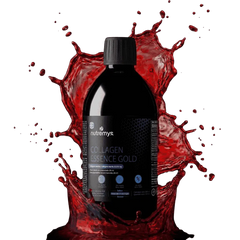
Collagen Essence Gold combines 12,500 mg of hydrolyzed marine collagen, retinol, hyaluronic acid, and vitamin C in a liquid formula with up to 3 times higher bioavailability than capsules.
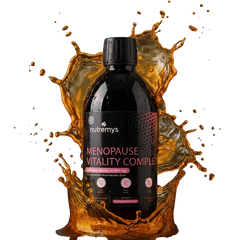
View Collagen Essence Gold → View Menopause Vitality Complex →Results Timeline: What Science Observes
Collagen production is a slow biological process. This is the first thing to understand before starting a cure — because unrealistic expectations are the main cause of premature abandonment, often precisely when the first effects begin to appear.

Hydration and skin comfort
The first noticeable effects concern skin hydration and a slight improvement in skin texture. These changes precede structural effects because hyaluronic acid, a cofactor in the formula, acts faster than the synthesis of new fibers.
Reduction of fine lines and improvement in firmness
The study by Proksch et al. (2014) — 69 women, 8 weeks, 10,000 mg/day — observed a 30% reduction in periorbital wrinkles and a 28% improvement in instrumentally measured hydration. These figures correspond to a precise dose and duration; they are not extrapolable to underdosed products.
Dermal density and elasticity
At 12 weeks, the same study reported a 65% improvement in skin elasticity measured by cutometer. Effects on nails — reduced breakage, improved strength — usually appear within the same timeframe. Effects on hair quality are reported by a fraction of participants.
Documented bone and joint effects
The randomized controlled trial by König et al. (2018) in 131 postmenopausal women showed a significant improvement in bone mineral density after 12 months of daily supplementation. Effects on joint pain and mobility are reported from the third or fourth month in osteoarthritis studies.
Gradual return to initial state
Discontinuation of supplementation leads to a gradual return to the initial state within four to six weeks, once the peptides are eliminated from circulation. This delay argues for continuous intake rather than fragmented cures — or for a maintenance dose of 5,000 mg/day after the initial course.
A minimum course of three months is necessary to assess efficacy on the skin. Six months for bone and joint effects. Any supplement that promises visible results in one week on skin structure operates outside the scope of what collagen biology allows.
What marine collagen does not do
Scientific credibility is also gained by what one does not say. Here are the limitations that any honest communication about marine collagen must name.
Marine collagen does not regulate hormones. It does not act on estrogen receptors, does not reduce hot flashes, does not improve sleep disturbed by menopause, and does not alter the hypothalamic-pituitary axis. For these symptoms, other active ingredients — soy and red clover phytoestrogens, Dong Quai, maca, B vitamins — have documented specific mechanisms of action that collagen does not.
It does not replace menopausal hormone therapy (MHT). These are two interventions with distinct biological targets. A woman on MHT can benefit from collagen supplementation as a complement — exogenous estrogens partially restore fibroblast regulation, and collagen provides the synthesis substrate — but one does not substitute for the other.
Finally, no clinical study can attribute a preventive effect on osteoporosis to marine collagen in the medical sense of the term. What science shows is support for bone mineral density in addition to other strategies — calcium, vitamin D, weight-bearing physical activity — as part of a comprehensive management plan. A preventive claim for a pathology would exceed the EFSA regulatory framework and is not based on available data.
1. Always with vitamin C. Essential cofactor — without it, synthesis is blocked downstream even with optimal peptide intake.
2. Stay adequately hydrated. Collagen is a hygroscopic protein. Its action is potentiated by general hydration of 1.5 to 2 liters per day.
3. Engage in weight-bearing physical activity. Strength training and walking mechanically stimulate fibroblasts and osteoblasts, promoting the integration of peptides into new fibers.
4. Limit tobacco and alcohol. Tobacco generates free radicals that degrade existing collagen at a rate 3 times higher. Alcohol inhibits fibroblasts and reduces the absorption of zinc and vitamin C.
5. Protect skin from UV. Ultraviolet rays are the leading exogenous cause of dermal fiber degradation — daily SPF 30+ sun protection is as important as supplementation itself.
Frequently Asked Questions about Marine Collagen and Menopause
doi.org/10.1159/000355523
doi.org/10.3390/nu11122557
doi.org/10.1021/jf048166l
doi.org/10.3390/nu10010097
doi.org/10.1111/j.1365-2133.1987.tb04228.x
doi.org/10.3945/ajcn.116.138594
pubmed.ncbi.nlm.nih.gov/41049371
efsa.europa.eu
Mature skin has its own beauty.
We nourish it, not mask it.
Collagen Essence Gold concentrates 12,500 mg of hydrolyzed marine collagen, retinol, hyaluronic acid, and vitamin C in a liquid formula with up to 3 times higher bioavailability than capsules. Clean label. No added sugar. No artificial additives.
Discover Collagen Essence Gold → See Menopause Vitality Complex →