


At a Glance
- The galenic form (liquid vs. capsule) influences the assimilation rate and the maximum dose deliverable per intake.
- A liquid formula is already in solution: it skips the disintegration step that a capsule must undergo.
- 10,000 mg of marine collagen is equivalent to 10 to 12 capsules — hardly sustainable daily, simple in 25 ml.
- Capsules still have advantages: fat-soluble active ingredients, micro-dosages, portability, taste neutrality.
- The most underestimated criterion is neither of these: it's adherence, regularity over 2 to 3 months.
1. Why the galenic form changes efficacy
When you swallow a capsule, its contents are not immediately available to your body. The shell must first disintegrate in the stomach, then the active ingredients must dissolve before they can pass through the intestinal wall. These two steps take time and vary depending on the quality of the capsule, the state of your digestion, and the presence of food.
A liquid supplement has a head start: its active ingredients are already in solution. There's no shell to dissolve, no potentially unabsorbed fragments. For a water-soluble nutrient, this means more direct availability. It's a matter of basic pharmacology, not marketing.

2. Absorption: What science really says
Let's be honest: bioavailability primarily depends on the active ingredient, not just the format. For magnesium, for example, research shows that the chemical form and solubility significantly impact assimilation: organic and soluble forms (like bisglycinate) are better tolerated and absorbed than oxide, which is poorly soluble (Schuchardt & Hahn, 2017). A liquid, by design, presents the active ingredient already dissolved — a favorable starting point.
Regarding nutrients, certain claims are firmly regulated by the EFSA: Vitamin C contributes to normal collagen formation, magnesium helps reduce fatigue and supports the normal functioning of the nervous system. It is these validated foundations, not mere promises, that should guide a serious formula.
3. The real problem is dosage
This is where the form becomes crucial. During menopause, the natural synthesis of collagen decreases by about 1% per year from age 35 and accelerates after estrogen levels drop. To provide a truly useful dose — around 10,000 mg of marine collagen per day — you would need to swallow the equivalent of 10 to 12 standard capsules. Every day. For months.
No one maintains a routine of twelve capsules daily. The liquid format resolves this bottleneck: it concentrates high doses in a single gulp, without gelatin or unnecessary fillers. And as we will see, it is this regularity — much more than the absorption peak of a single dose — that makes the difference over time. To understand which active ingredients truly deserve their place, read our article on what the best menopause supplement should contain.

4. When capsules remain the right choice
Liquid isn't the answer to everything, and claiming it is would be dishonest. In several situations, capsules remain truly relevant.
Isolated fat-soluble active ingredients
Certain vitamins (A, D, E, K) or sensitive active ingredients are sometimes preserved and dosed more simply in an oily capsule.
Micro-dosages
When a few micrograms are sufficient, the volume of a liquid provides no particular advantage.
On-the-go convenience
When traveling, a blister pack of capsules is simpler to transport than a bottle that needs refrigeration.
Taste sensitivity
The capsule is neutral. A good liquid compensates with a pleasant natural flavor, but preference remains personal.
For minerals, the key is not the liquid/capsule debate but the chemical form: a detail we elaborate on in our guide which magnesium to choose.
5. How to choose: The Reading Grid
Rather than making an absolute decision, compare based on the criteria that truly matter for your goal and daily life.
| Criterion | Liquid formula | Capsules |
|---|---|---|
| Disintegration stage | None (already in solution) | Necessary before absorption |
| High dose per serving | Excellent (e.g., 10,000 mg) | Limited (requires multiple capsules) |
| Excipients / bulking agents | Often reduced | Frequent (filling, coating) |
| Long-term adherence | High (one sip) | Variable if multiple capsules |
| Transport / storage | Bottle, refrigeration after opening | Very practical |

6. Signs you might benefit from supplementation
Supplementation is not always necessary. But certain signs, common during perimenopause and menopause, are worth considering — always in addition to a balanced diet and, if necessary, medical advice:
- Skin losing firmness and elasticity, brittle nails, thinning hair.
- Persistent fatigue and low energy despite adequate sleep.
- Fragmented sleep, nervous tension, irritability.
- Hot flashes or discomfort related to hormonal fluctuations — on this point, see our article on phytoestrogens and menopause.
- Feeling of "not recognizing oneself anymore": several discomforts simultaneously rather than just one.
If several of these signs resonate with you, a comprehensive formula — one that addresses several issues at once — often makes more sense than a single active ingredient.
The liquid form, designed for menopause
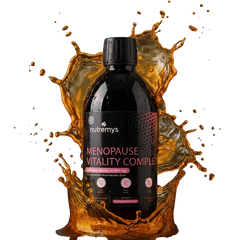
Discover the Menopause Vitality Complex: 30 active ingredients and 10,000 mg of marine collagen in a single daily liquid dose, without synthetic hormones.
Discover the formulaFrequently Asked Questions
Is liquid supplementation truly better absorbed than capsules?
For many water-soluble active ingredients, yes: the liquid is already in solution and does not need to disintegrate before being assimilated. However, bioavailability primarily depends on the active ingredient and its chemical form. The liquid format facilitates assimilation and allows for high doses; it does not compensate for a poorly dosed formula.
Liquid or capsules for collagen?
Collagen is taken in high doses (often 5,000 to 10,000 mg per day), which means numerous capsules. The liquid format is particularly suitable here: it delivers the dose in a single intake, without swallowing a dozen capsules. Opt for hydrolyzed collagen, which is better assimilated.
Does a liquid supplement taste good?
This depends on the formula. A well-designed formula uses natural flavoring (orange, red berries) without added sugar, making daily intake pleasant. This even contributes to regularity: a ritual you enjoy is less likely to be forgotten.
How long before I feel effects?
The first effects (energy, sleep) are often felt within 2 to 4 weeks. Benefits on skin, joints, and balance become established after 2 to 3 months of regular intake. Consistency matters more than the intensity of a single dose.
This article is for informational purposes only and does not replace medical advice. If you are currently undergoing treatment, are pregnant, breastfeeding, or have a history of hormone-dependent cancer, consult a healthcare professional before any supplementation.
- EFSA — EU Register of nutrition and health claims (Vitamin C & collagen, magnesium & fatigue).
- Schuchardt JP, Hahn A. Intestinal Absorption and Factors Influencing Bioavailability of Magnesium, 2017 (PMID 28392498).
- Proksch E. et al. Oral Supplementation of Specific Collagen Peptides Improves Skin Elasticity, Skin Pharmacol Physiol, 2014 (PMID 23949208).
- Franco OH et al. Use of Plant-Based Therapies and Menopausal Symptoms, JAMA, 2016 (PMID 27327802).
The information shared on this blog is for educational and informational purposes only. It does not replace medical consultation, diagnosis or treatment prescribed by a healthcare professional. If you have symptoms, are undergoing treatment or are pregnant, consult your doctor before modifying your diet or starting supplementation. Nutremys LAB food supplements should not replace a varied, balanced diet or a healthy lifestyle.
