





Menopause is a precise point: twelve consecutive months without menstruation. Perimenopause is the transition zone preceding it—often four to ten years during which hormones fluctuate irregularly. Paradoxically, this transitional phase is accompanied by the most symptoms, because sudden estradiol variations disrupt the body more than a stable and settled decline. Understanding which stage you are in doesn't change your biological age—but it transforms the most effective support strategy for your body now.
The two stages clarified — precise medical definitions
The confusion between perimenopause and menopause is one of the main sources of diagnostic uncertainty in women between 40 and 55 years old. This confusion is not insignificant: it often leads to passively awaiting "menopause" when one is actually only at the beginning of its long preparation. Precisely defining the terms is the first step to taking control.
Menopause, a precise point
Menopause, medically, is not a period. It is a precise point in time: the day it is noted that periods have stopped for exactly twelve consecutive months. Before this date, one cannot say that a woman is menopausal — there could be a new cycle. After this date, the diagnosis is retrospective and definitive. In France, the median age of menopause is 51, with a wide standard deviation: the vast majority of women experience it between 45 and 55 years old.
Perimenopause, a transition zone of 4 to 10 years
Perimenopause, on the other hand, is a period — often long. It begins when cycles start to become irregular and ends twelve months after the last period. Its average duration is four years, but it can extend up to ten years in some women. For many, it begins around 45, sometimes much earlier — as early as 38 or 40 in cases of early menopause or genetic predisposition. Concretely, this means that a 47-year-old woman experiencing hormonal symptoms is almost never "menopausal": she is in perimenopause, and this distinction must guide management choices.
Why this distinction changes everything for your health decisions
Perimenopause and established menopause do not demand the same things from the body. In perimenopause, hormonal fluctuations are the dominant signature: it is the variability that needs to be managed. In established menopause, it is the stable absence of estrogen that characterizes the terrain: the strategy changes radically. Confusing the two leads to inappropriate protocols — for example, treating perimenopausal hot flashes as if they resulted from established menopause, or conversely, underestimating the silent bone weakening that sets in after confirmed menopause.
Another important point: any vaginal bleeding after twelve months without periods is no longer a sign of hormonal fluctuation. It is a clinical event that requires evaluation. To understand what this may signal and how to react, read our complete guide on postmenopausal bleeding.

The hormonal mechanism that changes everything
To understand why the two stages are not alike, one must look at what happens biologically in the hypothalamus-pituitary-ovary axis. This understanding is not a biological detail: it is what explains why the approaches adapted to each are different.
The FSH-estradiol curve: what goes up, what goes down
FSH (follicle-stimulating hormone) is secreted by the pituitary gland to stimulate ovarian follicles. As ovarian reserve decreases, the ovaries respond less well — and the pituitary compensates by secreting more FSH. A longitudinal study published by the SWAN consortium (Study of Women's Health Across the Nation), involving thousands of women followed for up to eleven years, precisely documented the chronology: FSH begins to rise approximately six years before the last period, accelerates sharply in the two years preceding menopause, then stabilizes at a high plateau two years later.
Estradiol follows a more complex trajectory. During early perimenopause, it can be higher than normal at times — the pituitary stimulating less reactive ovaries sometimes produces unusual peaks. Then its average gradually declines, with marked oscillations. Only in postmenopause does estradiol settle at a low and stable level.
The STRAW+10 system — how doctors stage
To provide a common language for this transition, an international consensus of experts established the STRAW+10 system (Stages of Reproductive Aging Workshop) in 2012. It divides reproductive life into seven stages, of which the two central ones for our topic are:
- Stage −2 (early perimenopause): cycle duration variability greater than seven days compared to your normal. Periods are still present but the rhythm becomes unpredictable.
- Stage −1 (late perimenopause): an interval of sixty days or more between two periods, or amenorrhea of several months interspersed with menstrual episodes. This phase typically lasts one to three years.
- Stage +1 (early postmenopause): the first twelve months after the last menstruation. Hot flashes and mood instability can remain intense.
- Stage +2 (late postmenopause): beyond. The dominant issues become bone, cardiovascular, cognitive, and trophic (skin, mucous membranes).
The paradox: perimenopause is often more uncomfortable than established menopause
Here is one of the best-documented counter-intuitions in the literature: it is not women who have been menopausal for five or ten years who report the most symptoms, but those who are in the process of transitioning. It is the amplitude of variations that deregulates — not the low level itself. A body adapts to a new stable threshold, even if low. It adapts much less well to brutal and unpredictable oscillations. This mechanism explains why women aged 47-50, still having periods at intervals, can experience hot flashes, sleep disturbances, irritability, and brain fog with greater intensity than women with confirmed postmenopause.
Analysis of hormonal trajectories by the SWAN consortium (Tepper et al., Journal of Clinical Endocrinology & Metabolism, 2012) identified four distinct estradiol trajectories and three distinct FSH trajectories during the menopausal transition. Not all women go through this period in the same way: some see their estradiol levels drop relatively quickly, others experience prolonged high plateaus before the fall. This biological heterogeneity explains why the same supplementation does not yield the same results in two women of the same age.
Mirror symptoms — what changes according to the stage
Some symptoms are common to both stages; others are almost exclusively characteristic of one or the other. Knowing how to interpret this landscape allows you to identify which phase you are in — often without even needing a hormonal assessment.
Predominant symptoms in perimenopause
Perimenopause is primarily characterized by irregularity and the amplitude of variations. The most frequent manifestations are unpredictable cycles, altered bleeding (heavier or, conversely, shorter), new anxiety or irritability, often new sleep disturbances with no identifiable cause, brain fog that surprises by its suddenness, and the first hot flashes — initially sporadic, sometimes only at night.
This brain fog is one of the most unsettling symptoms because it directly affects perceived cognitive performance. To understand its mechanism and documented levers of action, read our complete guide on brain fog in perimenopause.
Symptoms in established menopause
Once menopause is confirmed, the landscape transforms. Abrupt fluctuations fade, replaced by the consequences of a stable but estrogen-poor hormonal environment. Then, more distinctly emerge: vaginal dryness and urogenital atrophy, silent bone weakening (density loss accelerates significantly in the first five years post-menopause), diffuse joint pain, a change in body composition (loss of lean mass, adipose redistribution), and a decline in skin collagen which can reach thirty percent in the first five years following menopause.
Hot flashes, contrary to popular belief, can persist long after established menopause. Data from the SWAN study indicate a median duration of approximately seven years, with cases extending beyond ten years. If they disrupt your sleep, our article on night hot flashes explains the precise mechanism and levers of action.
| Symptom | Perimenopause | Established Menopause |
|---|---|---|
| Irregular cycles / amenorrhea | Signature Lengthened, shortened, spaced cycles | Definitive absence No periods for ≥ 12 months |
| Hot flashes | Onset Sporadic, often nocturnal initially | Persistent Median ~7 years after menopause |
| Anxiety, irritability | Strong Linked to abrupt hormonal variations | Stable Less linked to hormones, more to context |
| Brain fog | Characteristic Often perceived as destabilizing | Decreases Often improving after transition |
| Sleep disturbances | Present Linked to night sweats + cortisol | Persistent May improve after stabilization |
| Vaginal dryness | Begins Often mild in late perimenopause | Worsens Progressive atrophy without support |
| Bone weakening | Subtle Already underway but silent | Accelerated Rapid loss in the first 5 years |
| Skin and collagen changes | Subtle First signs: elasticity, hydration | Marked Up to –30% collagen in 5 years |
| Joint pain | Appears Often morning, stiffness | Persists Linked to estrogen drop |

How to identify your stage — self-assessment
Before any hormonal assessment, clinical observation of your own cycles and symptoms already provides a reliable answer in the vast majority of cases. International learned societies — including the North American Menopause Society — recommend diagnosing primarily based on anamnesis, and reserving hormonal assays for ambiguous situations.
The 4 questions to ask yourself this month
Are my periods regular?
If your cycle duration has varied by more than seven days compared to your normal over the past few months, you are most likely in early perimenopause (STRAW stage −2).
Has there been a period of more than 60 days without periods?
A long interval without menstruation, sometimes followed by a spontaneous return, indicates late perimenopause (stage −1).
Has it been twelve months or more without periods?
If yes, without pregnancy or medical cause, you are postmenopausal. The diagnosis is retrospective and does not require hormonal confirmation.
What symptoms dominate today?
Unpredictable cycles + anxiety + sporadic sweats point to perimenopause. Dryness + loss of density + joint pain point to postmenopause.
The Cycle Journal — A Simple and Accurate Tool
Three months of rigorous observation are often worth more than an isolated hormonal assay. Note on a notebook (or an app) the date of each bleed, its duration, its approximate abundance, and the symptoms felt in the second half of the cycle. This record will be the most useful tool for your doctor during the consultation — much more telling than a vague phrase like "my periods are weird right now".
When a Hormonal Check-up Helps — and When It's Useless
FSH and estradiol testing is not very useful during full perimenopause, precisely because hormones fluctuate. An isolated test can be normal one day and completely disrupted two weeks later with no change in your experience. However, it is useful in two situations: suspected premature menopause before age 45, and preoperative or pre-hormonal treatment assessment. For the rest, anamnesis and observation are more valuable.
Certain signs should not be too quickly attributed to hormonal transition and require immediate medical attention: any bleeding after twelve months without periods, very heavy or prolonged bleeding (more than eight days), new and persistent pelvic pain, night sweats accompanied by fever or unexplained weight loss, and any rapid mood change accompanied by dark thoughts.
Strategies adapted to each stage
Once the stage is identified, the levers of action are not the same. Confusing a hormonal stabilization strategy (useful in perimenopause) with a long-term structural support strategy (essential in postmenopause) leads to irrelevant supplementation choices.
In Perimenopause: balancing fluctuations, supporting sleep and mood
The priority in perimenopause is to reduce the amplitude of experienced variations — less those of estradiol itself than their impact on the nervous system. This involves three axes: gentle hormonal regulation (phytoestrogens at physiological doses, which modulate without substituting), support for deep sleep (magnesium bisglycinate at the end of the day, blue light management in the evening), and management of the stress-cortisol axis (which directly amplifies hot flashes when it is deregulated).
In Established Menopause: bone density, skin, genital mucus, active longevity
When menopause is confirmed, the strategy shifts to long-term structural maintenance. Bone weakening is the most important silent issue — density loss accelerates significantly in the first five years, without symptoms before the first fracture. Targeted calcium intake, vitamin D3, and hydrolyzed marine collagen become relevant, supported by magnesium in the right form. Vaginal dryness and skin collagen decline require a combined local and systemic approach. For an exhaustive overview of the most useful micronutrients, read our guide to essential supplements after 50.
Signs you might benefit from supplementation
Regardless of the exact stage, certain recurring signals deserve to be taken seriously as indicators that targeted nutritional support could bring comfort: fatigue that does not subside with rest, fragmented sleep several nights a week, even moderate night sweats, new anxiety or irritability, morning joint pain, visible changes in skin firmness or hair quality, and decreased libido not explained by context.
In perimenopause: take your phytoestrogens and B vitamins with breakfast in the morning to support energy and thymic regulation throughout the day. In the evening, magnesium bisglycinate thirty to sixty minutes before bedtime to facilitate falling asleep and reduce awakenings related to night sweats.
In postmenopause: the priority shifts to regularity — hydrolyzed marine collagen every day (bone and skin benefits are seen after 3 to 6 months of continuous intake), vitamin D3 with a fatty meal for absorption, magnesium and calcium spaced throughout the day to avoid competing for mutual absorption.
To choose a truly suitable form of magnesium (not all are equal — oxide is up to four times less absorbed than bisglycinate), our complete guide to magnesium forms details scientifically validated selection criteria.

Frequently Asked Questions
This article is for informational and educational purposes only. It does not replace personalized medical advice. For any evaluation of your hormonal stage or therapeutic guidance, consult your doctor or gynecologist.
A Formula Designed to Support Both Stages
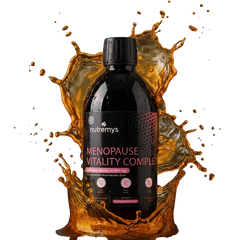
Menopause Vitality Complex combines hydrolyzed marine collagen, B vitamins, hyaluronic acid, and three targeted adaptogenic plants (red clover, dong quai, maca) in a highly bioavailable liquid formula. Designed to support both perimenopausal fluctuations and the structural challenges of postmenopause.
Discover Menopause Vitality Complex →


The information shared on this blog is for educational and informational purposes only. It does not replace medical consultation, diagnosis or treatment prescribed by a healthcare professional. If you have symptoms, are undergoing treatment or are pregnant, consult your doctor before modifying your diet or starting supplementation. Nutremys LAB food supplements should not replace a varied, balanced diet or a healthy lifestyle.
