


Ovarian Cysts After Menopause: Symptoms, Risks, and Monitoring
A cyst discovered after menopause is often a cause for concern. However, the majority are benign. How to recognize them, when to be alarmed, and how to intelligently support your body — here's what science truly says.
An ovarian cyst after menopause: common, often benign, always to be monitored
After menopause, ovaries are supposed to be "at rest." However, cysts can still form — most often asymptomatically, discovered during a routine ultrasound. More than 65% of detected ovarian cysts are benign (Fondation ARC, 2025). But at this age, every ovarian mass deserves a rigorous evaluation to rule out any worrying progression.
In this article, we explain why these cysts appear, how to recognize symptoms, what examinations are recommended, and how to distinguish a simple cyst from a situation requiring medical attention. This article is for informational purposes only and does not replace medical advice.
What is an ovarian cyst and why does it appear after menopause

An ovarian cyst is a fluid-filled sac that forms on or inside an ovary. During fertile years, it is a very common phenomenon — most disappear spontaneously with the menstrual cycle. But after menopause, when the ovaries no longer produce eggs, the presence of a cyst raises other questions. To better understand the stages of this transition, our perimenopause vs. menopause guide can be helpful.
🧬 Why do cysts still form?
After menopause, the ovaries no longer function in the same way, but they are not completely inert. Several mechanisms explain the appearance of cysts at this stage.
Even after the last cycle, some women still have small fluctuations in estrogen and progesterone capable of stimulating ovarian tissue and promoting the formation of functional cysts. Approximately 5% of menopausal women still have a functional cyst.
Treatments based on estrogen and progesterone prescribed to relieve menopausal symptoms can stimulate ovarian tissues and promote cyst development. This is a factor to monitor during gynecological follow-up.
Cystadenomas (serous or mucinous) and dermoid cysts are benign tumors that can develop independently of hormonal activity. They can reach a significant size and cause pain or abdominal pressure.
Obesity (which increases peripheral estrogen production), family history of ovarian or breast cancer, and genetic mutations (BRCA1, BRCA2) are factors that increase the risk of a cyst being of a worrying nature.
Different types of postmenopausal cysts
Not all cysts are alike. Their type, structure, and content determine the level of monitoring and the course of action. Here are the main types that can be encountered after menopause.
A retrospective study of 100 postmenopausal women who underwent surgery for ovarian tumors showed that 78% of cases were benign and 22% were malignant (PMC, 2015). A pure liquid ultrasound appearance (simple cyst) was found in 40% of cases, with a nearly zero risk of malignancy for unilocular cysts less than 5 cm. The authors conclude that ultrasound monitoring is justified for asymptomatic simple cysts, reserving surgery for high-risk situations.
Symptoms and warning signs to know

In the majority of cases, postmenopausal ovarian cysts are silent — discovered by chance during a routine examination. But when they do manifest, symptoms can be subtle and easily attributed to other causes. Knowing how to recognize them allows for timely action.
📋 Common symptoms
Persistent or intermittent, often localized to one side
Feeling of fullness, unexplained abdominal distension
Frequent urges to urinate, pressure on the bladder
Exhaustion, nausea, feeling of pelvic heaviness
🚨 Warning signs — consult quickly
Certain signs require immediate medical consultation. After menopause, these situations always warrant a thorough evaluation.
Any vaginal bleeding after confirmed menopause (12 months without periods) is always a warning sign. It can have several causes — cyst, polyp, atrophy — but it must always be evaluated. If you still have irregular bleeding, our article on perimenopausal bleeding can help you distinguish.
A rapidly swelling abdomen, a palpable mass, or unexplained waist gain may indicate a voluminous cyst or fluid accumulation (ascites) requiring urgent imaging.
Intense and sudden pelvic pain can signal ovarian torsion or cyst rupture — both surgical emergencies. In case of severe pain accompanied by nausea or malaise, go to the emergency room.
Involuntary weight loss associated with significant fatigue and persistent digestive problems should always lead to a complete medical evaluation to rule out a serious pathology.
Diagnosis: recommended examinations

The diagnosis of a postmenopausal ovarian cyst is based on a stepwise approach, combining imaging, blood tests, and, if necessary, additional examinations. The objective: to characterize the cyst and accurately assess its risk of malignancy.
This is the first-line examination. It allows visualization of the size, shape, content (pure fluid, septa, solid components), and vascularization of the cyst. A simple, unilocular cyst, less than 5 cm, without abnormal vascularization, is almost always benign.
CA-125 is a blood tumor marker. After menopause, a high CA-125 level is a strong argument for malignancy. However, this marker can also be elevated in benign situations (residual endometriosis, inflammation). It is therefore always interpreted in context, never alone.
Prescribed when ultrasound cannot precisely characterize the cyst: voluminous cyst (> 7 cm), suspicion of dermoid cyst or endometrioma, or cyst with mixed appearance. MRI offers superior tissue resolution and allows for better evaluation of the peritoneum and lymph nodes.
In case of suspicion of malignancy, a thoraco-abdomino-pelvic CT scan (extension assessment) or diagnostic laparoscopy may be proposed. Biopsy is generally not performed on the cyst itself (risk of dissemination) — analysis is done after surgical removal.
A simple cyst less than 5 cm, asymptomatic, with normal CA-125 can be monitored by ultrasound every 3 to 6 months. More than 50% of these cysts disappear spontaneously. In contrast, a complex cyst, a cyst that increases in size, an elevated CA-125, or suspicious symptoms lead to surgical management — most often by laparoscopy, a less invasive technique with rapid recovery (CNGOF, 2013).
Monitoring, treatment, and holistic support
Whether the cyst requires monitoring or intervention, holistic body support during this period is essential. Menopause is a phase of high metabolic demand, and supporting hormonal, inflammatory, and immune functions contributes to overall well-being.
< 5 cm
or symptomatic
or complex
🌿 Signs that you might benefit from supplementation
Regardless of a cyst, menopause places the body in a state of increased nutritional demand. If you experience several of these signs — persistent fatigue, dry and dull skin, hair loss, irritability, joint pain, chronic bloating — targeted nutritional support can be particularly helpful. This is not about treating the cyst, but about globally supporting your body during this transition.
Decreased estrogen accelerates bone density loss. Vitamin D3 combined with K2 optimizes calcium absorption into the bones. Regular vitamin D testing is recommended after age 50. Discover our article on vitamin D3 and its cofactors.
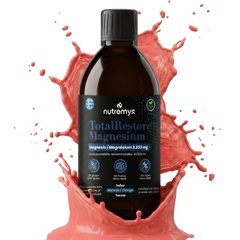
Magnesium supports the nervous system, sleep quality, and muscle relaxation. B vitamins (B6, B9, B12) are involved in hormonal metabolism and serotonin production. If brain fog is part of your daily life, these nutrients are a priority.
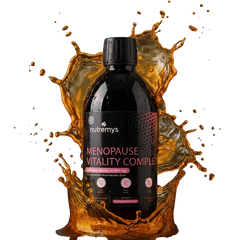
Nutremys's Menopause Vitality Complex combines 31 active ingredients in a highly bioavailable liquid formula: marine collagen (10,000 mg), phytoestrogens (red clover, dong quai, maca, ashwagandha), magnesium, vitamins D3, K2, C, E, full B complex, hyaluronic acid, elastin, and CoQ10. A synergistic approach designed for this stage of life — not a treatment, but intelligent nutritional support. For a more comprehensive guide, see our article on essential supplements after 50.
Maintaining a healthy weight reduces the production of peripheral estrogens by adipose tissue — a known factor in ovarian stimulation. Regular physical activity (30 minutes of walking, yoga, swimming) supports hormonal regulation, cardiovascular health, and mood. Finally, an annual gynecological check-up with pelvic ultrasound is the best prevention tool after age 50.
FAQ — Frequently asked questions about ovarian cysts after menopause
pmc.ncbi.nlm.nih.gov
fondation-arc.org
cngof.fr



The information shared on this blog is for educational and informational purposes only. It does not replace medical consultation, diagnosis or treatment prescribed by a healthcare professional. If you have symptoms, are undergoing treatment or are pregnant, consult your doctor before modifying your diet or starting supplementation. Nutremys LAB food supplements should not replace a varied, balanced diet or a healthy lifestyle.
